 |
June 18, 2026
Do Weird People Know They’re Weird?
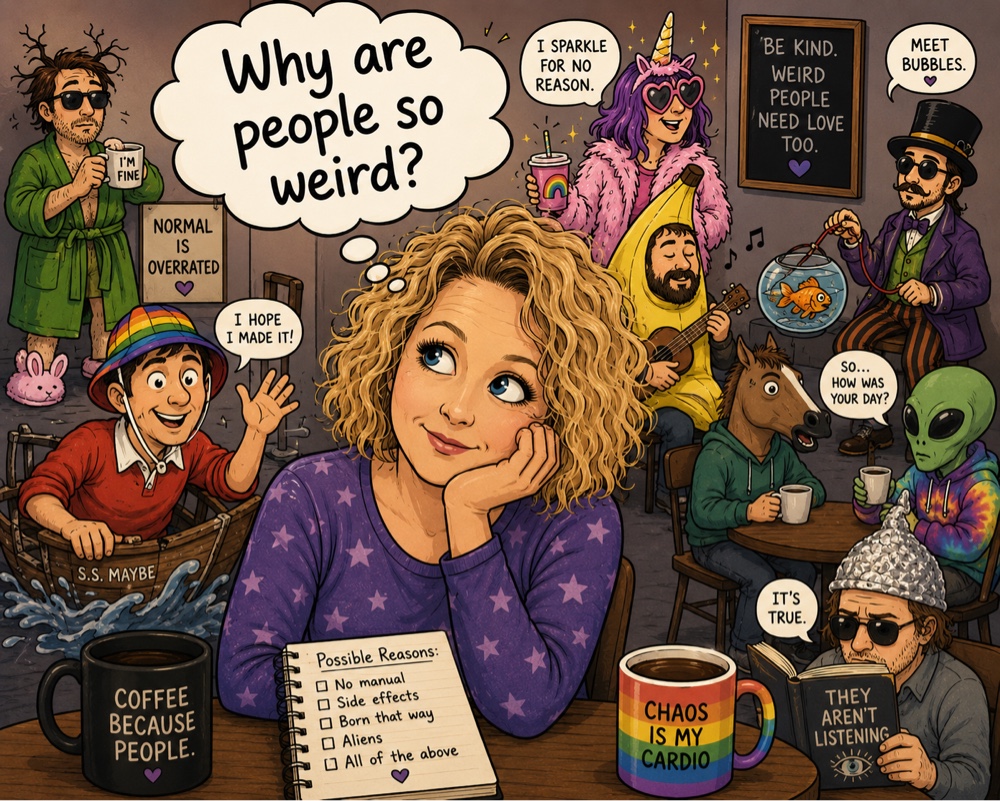 |
One of the things I spend an embarrassing amount of time thinking about is whether weird people know they’re weird. Not bad weird. Not dangerous weird. Just the kind of weird that makes you stop for a second and think, “Well, that’s certainly a choice.” Like wearing a tail and cat ears. Come on now… that’s weird.
The other day I saw a guy walking down the street wearing an outfit that looked like he got dressed during a power outage. Nothing matched. The hat made no sense unless he was someone’s little buddy on a stranded island during Pride month. His walk had a little extra drag to it. And yet he looked completely confident, like he owned the sidewalk.
It got me wondering. Does he know why people are looking at him? Or does he think he’s perfectly normal and the rest of us are the odd ones? Then I made the mistake of thinking about it too long. What if weird people don’t know they’re weird? More importantly, what if I’m weird and do know it?
I mean, I talk to myself. A lot. My husband is forever asking, “Who are you talking to?” And I answer with complete confidence, “Myself!” Sometimes I need expert advice.
Nobody has ever staged an intervention for me. I’ve managed to keep friends, jobs, relationships, and a reasonably good reputation. But maybe every weird person says the exact same thing.
The more I thought about it, the more I realized everybody has their thing. Some people wear strange hats. Some people collect things nobody understands. Some people sing to their pets or name their plants. I talk to myself. We all have our quirks.
Maybe normal is just a group of weird people agreeing not to point fingers at each other. And maybe being a little weird isn’t something to hide. It’s part of what makes us interesting. The world would be pretty boring if everyone acted exactly the same.
So I’ve decided it’s okay to be weird. Wear the odd hat. Talk to yourself. Collect strange things. Dance in your kitchen. As long as you’re happy, not hurting anybody, and not asking me to wear cat ears, I think we’re all going to be just fine.
June 17, 2026
Visiting Sleeping Beauty
I went to see my mom today like I do most Wednesdays. She’s in a nursing home now, where she should be receiving round-the-clock care, but we still go see her and check in. Just because someone lives in a facility doesn’t mean you stop being their family.
She has pretty much stopped using her phone. I don’t think she has much interest in it anymore. I usually call before I leave and tell her to expect me, but this time I didn’t because she doesn’t answer the phone anyway.
When I got there, she was sound asleep after a busy morning. And I mean sound asleep. I couldn’t wake her up. She didn’t want to wake up either. She was perfectly content being asleep.
This is exactly why I always called first. From now on, I’ll make sure she’s awake and expecting me before I make that two-hour drive.
The day wasn’t wasted because any day you get to see your mom is a gift, especially at 92 years old. But I have to admit, I don’t really want to drive two hours to visit Sleeping Beauty.
I guess that’s one of the strange things about this season of life. As our parents age, we adjust right along with them. We learn new routines, new expectations, and sometimes we learn that even our visits need a little planning.
Next Wednesday, Sleeping Beauty is getting a wake-up call.
The People Willing to Raise Their Hand
It’s easy to sit in our living rooms, scroll social media, and complain about our government. We complain about roads, schools, taxes, regulations, crime, and the direction of our communities. We talk about what should change and how someone ought to fix it.
But then election time comes around, and most of us vote for the same people over and over again and expect different results.
The truth is, holding public office is hard work. It’s long meetings, endless phone calls, criticism from every direction, and decisions that make one group happy while making another group angry. It’s missed family time, constant scrutiny, and carrying the weight of thousands of opinions on your shoulders.
And it takes courage to even run in the first place.
You have to put your name, your reputation, and sometimes your family in the public eye. You have to be willing to have strangers judge your motives, criticize your past, and pick apart your every decision before you’ve even won the election.
Most people aren’t willing to do that.
Whether you agree with a candidate or not, there is something admirable about anyone who raises their hand and says, “I’m willing to serve. I’m willing to try. I’m willing to be held accountable.”
Real change rarely happens by complaining from the sidelines. It requires people willing to step into the arena and communities willing to consider new ideas and new voices.
If we keep electing the same people and expecting different outcomes, we shouldn’t be surprised when nothing changes.
Democracy asks two things of us: the courage to run and the willingness to thoughtfully choose who leads. Neither is easy. But both matter.
Subscribe to:
Posts (Atom)